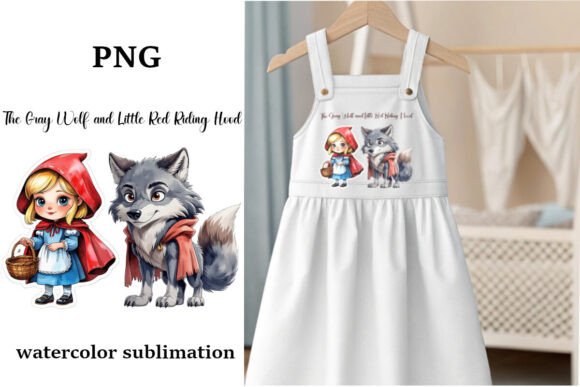
Reviewing the Gray Wolf and Little Red Riding Hood Wat Design
As a designer who has spent years digitizing patterns and testing files for real-world production, I approach every new asset with a critical eye. We are not just looking at pretty pictures; we are evaluating how an image translates into thread, how it holds up on fabric, and whether it will resonate with the end customer. Today, I am taking a close look at the Gray Wolf and Little Red Riding Hood Wat, a watercolor-style sublimation PNG that promises a whimsical yet sophisticated aesthetic for creative projects.
This is not a standard machine embroidery design file with pre-programmed stitch paths. Instead, it is a high-resolution graphic intended for sublimation or print-based applications, which changes how we must approach its integration into our handmade products. Understanding this distinction is crucial for any Etsy seller or craft business owner looking to maintain quality control.
First Impressions: Mood and Visual Personality
The first thing that strikes me about the Gray Wolf and Little Red Riding Hood Wat is its softness. Watercolor illustrations rely on bleeding edges and translucent layers, which creates a dreamy, storybook atmosphere. The layout balances the predatory nature of the wolf with the innocence of Little Red Riding Hood, resulting in a composition that feels more like a gentle narrative than a frightening encounter. This mood is essential for specific market niches, particularly nursery decor and children’s apparel, where harsh lines or aggressive imagery are often avoided.
The detail level in this Illustrations category asset is significant. At 300 DPI and sized at 10 x 12 inches, the resolution is sufficient for crisp printing. However, from an embroidery perspective, this level of detail presents a challenge if one were attempting to recreate it purely with thread. Since this is a graphic, it serves best as a printed element that can be combined with embroidery accents, rather than a standalone stitched piece.
Real-World Application: The Custom Tote Bag Scenario
To test the viability of this design, let us imagine a common scenario for a small shop product: a custom canvas tote bag. Canvas is a sturdy, textured fabric that takes well to both printing and heavy stitching. If I were using the Gray Wolf and Little Red Riding Hood Wat for a boutique listing, I would sublimate the main illustration onto a white polyester-blend panel or use direct-to-garment printing on cotton.
However, to elevate this from a simple printed bag to a high-value handmade product, I would add embroidery details. Imagine stitching the outline of the wolf’s ears or the hood of Little Red Riding Hood using a satin stitch in matching thread colors. This hybrid approach leverages the clarity of the digital graphic while adding the tactile luxury of thread. Customers perceive this combination as higher effort and higher quality, justifying a premium price point for your Etsy seller profile.
Navigating Fabric and Production Constraints
While the visual appeal is strong, we must discuss where this design requires caution. Because watercolor effects rely on subtle gradients, placing this graphic on dark fabric without a proper white underbase or light-colored garment will result in muted, muddy colors. The vibrancy of the Graphics depends entirely on the background contrast.
If you are considering this for custom apparel like sweatshirts, be mindful of the fabric texture. Fleece and heavy cotton blends can distort fine details if the printing method is not precise. Furthermore, if you plan to incorporate this into an embroidered patch via heat transfer, ensure the adhesive backing does not interfere with the soft hand-feel of the watercolor aesthetic. Stiff patches on soft baby clothes can be uncomfortable, so this design is better suited for larger surface areas like pillow covers or aprons where stiffness is less noticeable.
For those thinking about caps or curved surfaces, remember that the 10 x 12 inch dimensions are quite large. You would need to scale the design down significantly. When scaling down watercolor art, the finest details may blur. Always test a printed proof on scrap fabric before committing to a final finished product.
Enhancing Brand Consistency and Customer Trust
Using cohesive design assets is key to building a recognizable brand. The Gray Wolf and Little Red Riding Hood Wat fits seamlessly into a fairy-tale or woodland-themed collection. If your shop specializes in holiday embroidery or storybook-inspired gifts, this illustration reinforces your niche authority. Consistency in style builds customer trust; buyers know what to expect when they see your listings.
Moreover, the versatility of this PNG allows for diverse marketing materials. You can use it in printable mockups to showcase potential products without physically producing every item. This saves time and resources for creative entrepreneurs who need to maintain a steady flow of new listings. Whether used for baby embroidery previews or tote bag design concepts, the high resolution ensures your digital presence looks professional.
Practical Notes for the Embroidery Designer
Before integrating this asset into your workflow, consider these practical steps:
- Check Licensing: Confirm whether the license allows for commercial use on physical goods. Some digital files are for personal use only, so verify this before selling small shop products.
- Test Color Contrast: Print the design on both white and light gray fabric swatches. Watercolors can disappear on off-white backgrounds. Ensure the thread colors you choose for any accompanying embroidery complement the printed hues rather than clash with them.
- Stabilizer Selection: If you are combining this print with embroidery, use a cut-away stabilizer for stretchy fabrics like t-shirts to prevent distortion during stitching. For woven fabrics like canvas, a tear-away may suffice.
- Inspect Detail Clarity: Zoom in to 100% on your screen. Check the edges of the wolf’s fur and the girl’s cloak. If the pixels appear jagged, the file may not be suitable for large-format printing without further enhancement.
- Hoop Size Planning: If adding embroidered accents, measure your hoop size carefully. Ensure the embroidery frame does not overlap critical parts of the printed image unless intended.
Final Verdict on Usability
The Gray Wolf and Little Red Riding Hood Wat is a compelling asset for designers who understand the difference between stitch files and print graphics. It excels in applications where softness and narrative are valued, such as nursery decor, children’s clothing, and literary-themed gifts. While it requires careful handling regarding fabric choice and color contrast, its high resolution and artistic charm offer significant potential for value-added products.
For the craft business owner willing to experiment with mixed media—combining sublimation prints with strategic satin stitch or running stitch accents—this design can become a standout item in your portfolio. It invites creativity beyond the hoop, encouraging makers to think holistically about how graphics and thread work together to create memorable personalized gifts. Use it wisely, test thoroughly, and let the story of the wolf and the girl bring a touch of whimsy to your next embroidery project.